You planned to take a walk after lunch. Lunch ran late, then a call ran long, and by evening the walk was gone. Now the calendar has a blank square where you expected a neat row of checks.
You do not need to repay that square. A missed day is useful information. Something about the habit, its timing, or the day around it made the action harder than you expected. Look at that information, choose the smallest honest return, and carry on.
What should you do after missing a day?
Find out what actually got in the way before you decide anything about yourself. “I'm bad at habits” is a big explanation for a small event. Ask what happened just before you would usually do it.
Maybe the walk depended on lunch ending on time. Maybe your shoes were at home. Maybe you had enough energy for ten minutes outside but not the full route you had imagined. Each answer suggests a different change. A vague judgment about yourself suggests none. If the whole day keeps overflowing, the habit may not be the real problem, and planning a day when everything feels urgent may help more than a stricter habit.
Write one sentence, on paper or in a journal entry, without trying to make it sound noble. “The call took my lunch break” or “I forgot until it was dark” will do. You are describing the setup, not building a case against yourself.
Should you make up for the missed day?
No. After a miss, it is tempting to double tomorrow's target, but that turns one ordinary disruption into two harder days. Try a return version you could do even if tomorrow is only slightly better than today.
For a walk, that might be one loop around the block. For a reading habit, two pages. For a habit of keeping in touch, a short message instead of a long call. The return version should still be the action you care about. It is not a trick to win a checkmark.
If the original target no longer fits your week, change it openly. You can keep the intention and make the action smaller. If the intention itself no longer matters, it is also okay to stop. A habit is a tool for a life you want, not a contract with a past version of you.
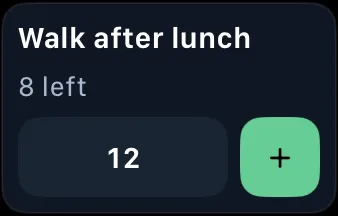
If you measure a habit in Monk & Monkey, a shorter version still goes on the record: the walk below logged 12 of its 20 minutes. A streak counts a day only once it reaches the target, so when the smaller version becomes the real one, lower the target rather than collecting short days as misses.
How do you make the next attempt easier?
Give the smaller version a moment that already happens, and remove one bit of friction. A useful habit needs a place to happen. Instead of relying on “sometime tomorrow,” connect the return version to something already on your day. Try after you put down your lunch plate, before you open your laptop, or when you come home.
Psychologists call a plan in the form “when this happens, I will do that” an implementation intention. A 2006 review of 94 independent tests by Peter Gollwitzer and Paschal Sheeran found that people who made such plans did better at reaching their goals than people who only intended to.
Then remove one bit of friction. Put the shoes by the door. Leave the book where you sit. Draft the first line of the message. These changes are small enough to feel almost silly, which is fine. They make the next action easier to see when the day gets noisy.
Pick just one adjustment. If you redesign your entire routine every time you miss a day, the redesign becomes the routine.
Does one missed day ruin a habit?
No. In a 2010 study of habit formation led by Phillippa Lally, volunteers repeated one eating, drinking or exercise behavior every day for twelve weeks, and missing a single day did not materially affect how the habit formed. The study was small and people rated their own habits, so read it as reassurance, not a guarantee: doing the behavior regularly still mattered.
A streak can remind you that you have returned to something many times. It cannot explain why yesterday was difficult, and it cannot decide whether the habit still belongs in your life.
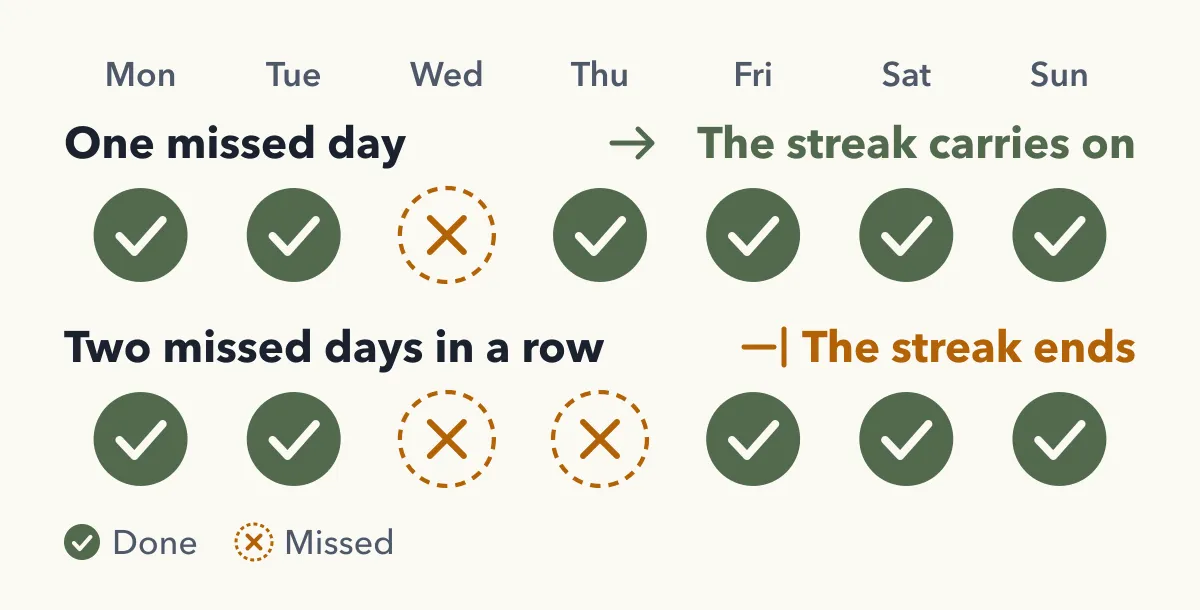
If you track habits in Monk & Monkey, you can log the next time you do the habit and see the pattern over time. The app's streak calculation allows one missed scheduled day before a second consecutive miss breaks the run, a rule some people call “never miss twice.” That breathing room can be useful, but the more important question is what will make the next attempt possible.
Longer breaks happen too. When you open the app after three or more days away, it offers to keep a streak that the time away ended, for breaks of up to 30 days, and you can undo that.
If you miss again, go back to the setup. Maybe the chosen time keeps colliding with work. Maybe the action needs a smaller return version. Maybe another goal deserves the space right now. You can make that decision without pretending the previous attempts never happened.
Try a two-minute reset
Take a note or open your habit list and finish these three sentences:
- I missed it because ______.
- The smallest useful return is ______.
- I will try it after ______.
For the walk, you could write, “I missed it because lunch became a call. The smallest useful return is ten minutes outside. I will try it after I put my plate away.”
That is enough of a plan for tomorrow. You do not have to feel newly motivated tonight. Give the habit a reasonable place to land, then let the next day tell you what needs adjusting.