Where did the week go?
Friday arrives and the unfinished tasks are louder than the finished ones. Look at completed work and focus time to see what actually filled the week.
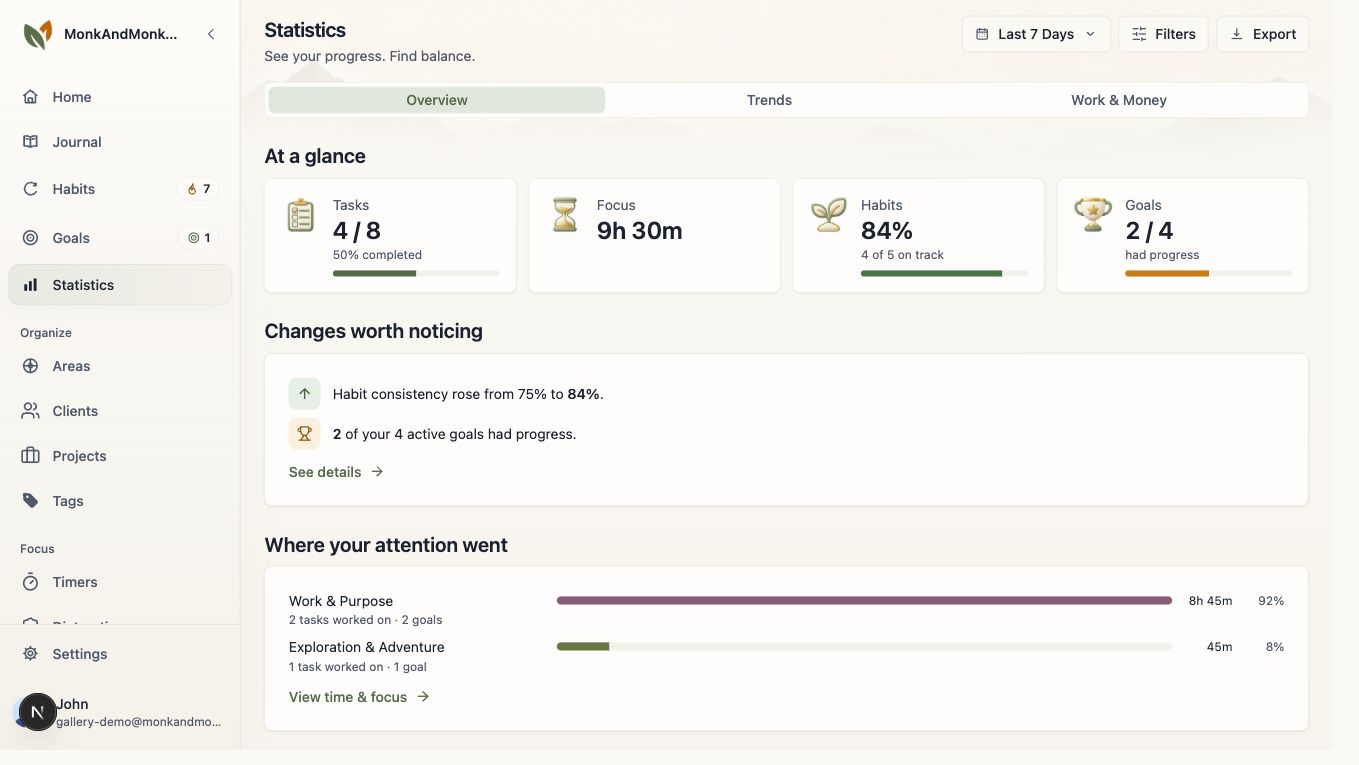
Review a week without grading it
Start with one question, such as whether you made time for the project you chose. Look at completed tasks and focus sessions, then compare those records with what you remember. If a meeting-heavy week left little room for that project, the next useful move might be a smaller task or a different time slot. A chart cannot tell you what the meetings required or why the choice mattered.
Keep activity types distinct
Completed tasks tell you what reached an endpoint. Focus time tells you how long a session lasted. Those are useful facts, but they answer different questions. A demanding task may take a long session, while a short task may matter just as much.
Follow a trend, then ask why
A trend can show a change; your own context explains it. Use the numbers as a starting point for reflection.
Know what the numbers leave out
The overview can bring activity into one place, but it cannot measure your worth, attention, or how demanding a task felt. A long session is not automatically better than a short one. Use the journal if you want to remember the circumstances behind a change. Treat a trend as a prompt for a question you can answer, not an automatic recommendation about how to live.